
Marion Projected Versus Actual Release
IDOC uses three labels that answer different questions. Projected Parole Date estimates when a confined person may leave prison for parole or mandatory supervised release. Parole Date records the realized prison-release event. Projected Discharge Date estimates when the sentence and supervision may end. None should be shortened to simply “release date” without its label.
A county detainee awaiting trial usually has no sentence-based date. A judge may issue a release order, but holds, warrants, transfer needs, or processing can keep the person in custody. A sentenced county-jail inmate may have a term and custody credit, yet Marion County has not published a jail-specific credit formula or routine release schedule.
Find Marion Projected Release Dates
Classify custody first. The IDOC Individual in Custody Search applies after a state-prison commitment. The Marion sheriff and court records apply to a county stay. These systems can overlap during transfer, but they do not publish the same event.
- Collect the full name, birth date, case number, booking number, and IDOC number if known.
- Check the Marion County case on Judici. Read the sentence, custody credit, warrants, and later orders.
- If sentenced to IDOC, search by IDOC number when possible. Otherwise use last name or birth date.
- Match the photo, aliases, conviction county, mittimus number, and offense lines.
- Read status and location with each exact date label.
IN CUSTODYplus a projected date is not release. - Use VINE Inmate Check for supported event alerts, then confirm with the reporting agency.
- For county timing, ask the sheriff for the exact discharge or transfer timestamp after processing.
If a completed IDOC record no longer appears, the IDOC FAQ directs users to archived Record Search through Contact Us. Supply identity, approximate admission year, known facility, conviction county, and dates.
Illinois Sentence Credit Rules
730 ILCS 5/3-6-3 controls Illinois sentence credit through offense-, date-, and sentence-specific rules. IDOC describes determinate sentences that may fall within 50%, 75%, 85%, or 100% service frameworks. Those percentages are shorthand, not a calculator.
First-degree murder and terrorism categories named in the statute receive no sentence credit. Listed violent offenses limited to 4.5 days of credit per month create the familiar approximate 85% framework. Listed serious drug offenses limited to 7.5 days per month correspond roughly to 75%. Other qualifying terms may earn one day for each day served. The conviction, offense date, enhancements, and exact subsection control.
Program credit has exclusions. IDOC says those required to serve 100% or 85% are not eligible for programming credit even if they take part in programs. Earned Sentence Credit is discretionary, includes an eligibility review, and cannot be forecast for one person. Never subtract a broad percentage from the imposed term.
Why Marion Release Dates Change
A projection can move without the earlier display being false. It reflects facts and credits known to IDOC at that point. A later profile may incorporate an award, sanction, court order, or sentence structure.
| Factor | Possible effect | Confirm with |
|---|---|---|
| Pretrial custody credit | Changes credited time | Judgment and IDOC calculation |
| Concurrent or consecutive terms | Changes sequence | Mittimus and sentence lines |
| Disciplinary loss or restoration | Moves projected timing | IDOC records |
| Program or earned credit | May reduce time if awarded | Updated profile |
| Later court order | May revise authority | Docket and amended order |
| Hold or detainer | May cause custody or transfer | Holding agencies |
County time can enter statutory calculations in some cases. No current Marion County local jail-credit formula was found. Ask the sentencing court, jail, or IDOC to explain the official calculation.
Confirm Marion Release Dates
Modern determinate Illinois sentences generally lead to mandatory supervised release after the prison term less applicable credit. They do not require a traditional parole vote in every case. Section 3-3-3 distinguishes older indeterminate parole from determinate-sentence release to MSR.
An IDOC status of PAROLE means the person physically left state prison for community supervision. It does not mean the sentence ended. Review the parole district and projected discharge date, then use Post-Release Supervision to verify status. Final discharge is supported by an IDOC/PRB record and the court entry contemplated by 730 ILCS 5/3-3-8.
Register through Illinois VINE for available custody-change alerts. Save the notice and call the reporting agency to learn whether it reflected community release, transfer, or return to custody. A warrant, federal hold, another county case, or immigration detainer can change where a person goes.
Read Marion IDOC Date Fields
The public profile combines identity, custody, date, and sentence details. Use it as a whole. Compare aliases, birth date, physical details, photograph, conviction county, and mittimus number before choosing a result.
The official example profile demonstrates projected parole and discharge labels.
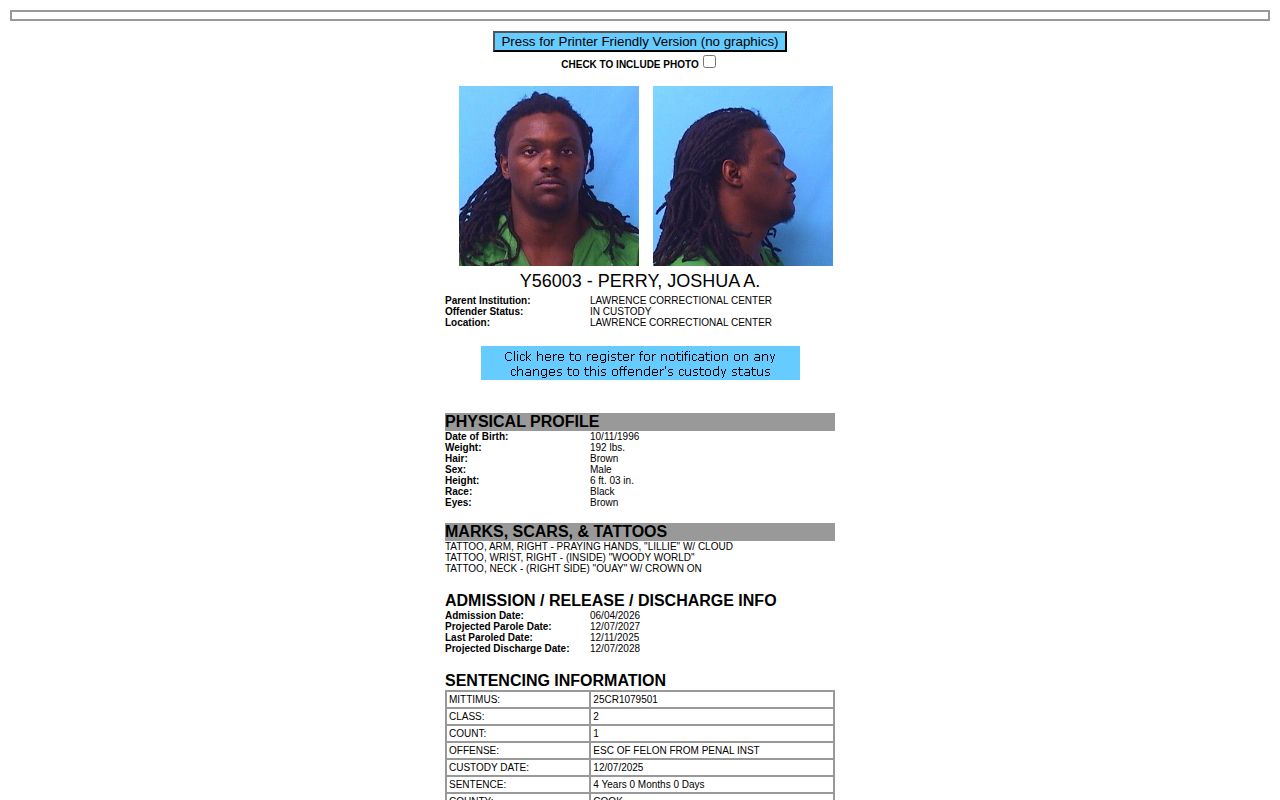
The state layout ties a projection to one profile. Review every sentence line because an older sentence marked discharged can coexist with a current undischarged term. Use the IDOC number as the archive key when possible.
Marion County Jail Release Timing
No authoritative local source publishes exact processing hours, weekend practice, an exit door, or a jail-specific good-time calculation. A court order can authorize release without proving when the jail completed hold review and physical departure.
After the event, request the sheriff’s chronological arrest information and booking/release record. Illinois FOIA §2.15 includes the time and date an incarcerated arrestee was discharged from or transferred from agency custody. Ask for the release type and receiving agency. That distinction prevents a transfer to IDOC, another jail, or federal custody from being mistaken for community release.
The Marion County released-inmate record path explains how to combine the sheriff timestamp with a court order. For formal proof, ask whether a certified or custodian-authenticated copy is available.
Prove Marion Release Dates
Different records prove different points. An IDOC parole date establishes prison departure into supervision. A sheriff entry establishes when county custody ended. A court order explains legal authority, and a PRB discharge order can establish the later end of a state sentence.
Save each exact label and observation date. For a stable copy, ask IDOC for public admission, release, status, and sentence information. Ask the sheriff for the booking/release report and exact discharge or transfer time. Request a certified court order when formal court proof is needed.
Federal custody requires another check. The Marion jail has housed USMS contract prisoners, and USMS has no public release locator. Use the federal docket and later BOP locator. A BOP released status proves departure from BOP, not the end of federal supervision or all other custody.
Check every active case and hold. Authority to release in one matter may coexist with a warrant or commitment in another. A hearing date or signed order cannot substitute for the holding agency’s completed-event record.
Older Marion Release Projections
A former IDOC person may drop from the live results while archive information remains available. Use IDOC Contact Us and select Record Search. Provide the IDOC number, full name, birth date, approximate intake year, facility, conviction county, and relevant dates.
A past screenshot is a lead, not a current certification. Ask for the admission date, release date, status history, and sentence data within IDOC’s public scope. Then cross-check the Marion case and any PRB discharge entry.
Marion Release Date Cautions
Do not turn a projection into travel instructions. No local source supports a guaranteed day, hour, exit, weekend practice, or pickup point. IDOC can revise its calculation, and county release can await review of other authority. Ask the holding agency for current instructions only after it confirms that release is being processed.
A VINE or sheriff-app notice can help establish a recent custody change, but it may describe transfer. Preserve the notice and ask which agency received the person. The court order explains why release was authorized; the jail or prison record shows when custody actually ended.
Truth-in-sentencing shorthand also needs care. Illinois law includes 50, 75, 85, and 100 percent service frameworks, but the controlling percentage depends on the offense, offense date, judgment, and exact statutory subsection. Some people cannot receive program credit even if they take part in a program. Earned Sentence Credit is discretionary, requires an eligibility review, and cannot be forecast for one person. Pretrial credit, consecutive terms, discipline, appellate action, and later sentence changes can also alter the profile. Read the current IDOC date instead of producing a private calculation from the sentence length.
Public Record Search
Sponsored Results